




Putin-Erdogan Meeting In Kazakhstan: Could Turkiye Bring Peace To Ukraine?
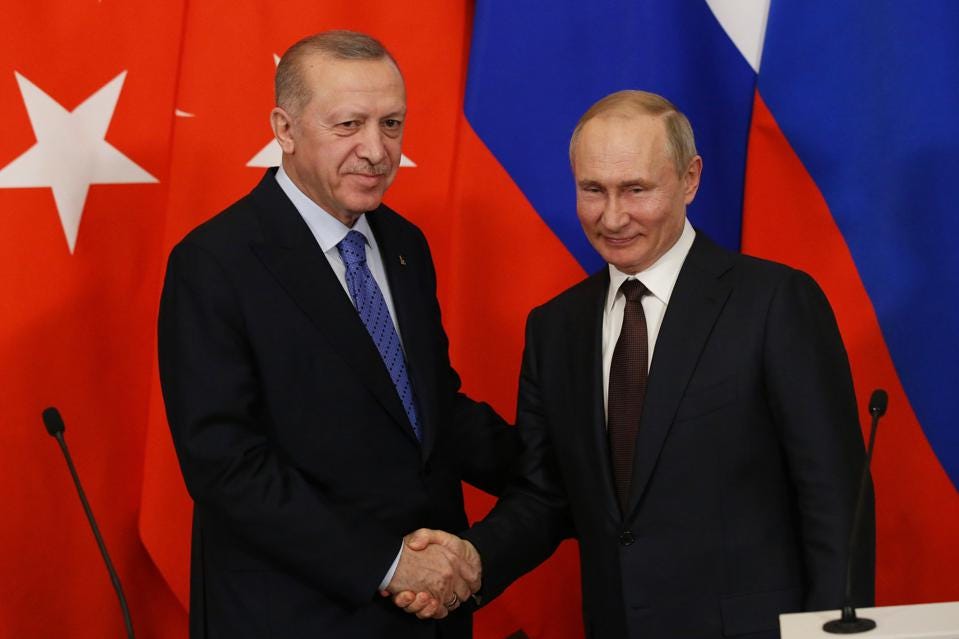

Turkish President Recep Tayyip Erdogan will meet his Russian counterpart Vladimir Putin later today at the Conference on Interaction and Confidence-Building Measures in Asia (CICA) in Astana, Kazakhstan.
Erdogan had publicly stated that he hoped to bring Putin and Ukrainian President Volodymyr Zelensky together for talks to end the war in Ukraine.
Turkish sources say that the government hopes to organize a summit in Istanbul on 25 November to propose a cease-fire and establish a committee to explore ways to return Ukraine and Russia’s borders to what they were in 2014.
Erdogan’s decision to reach out to Russia comes as the U.S. and Russia have both announced their intention to have talks. The White House national security spokesperson John Kirby stated that the United States was willing to have talks, but Russia refused. In response, Russian Foreign Minister Sergei Lavrov said they had “not yet” been offered any contact from the US. The Russian foreign ministry has also reiterated its desire for diplomacy and blamed the United States for preventing it.
On the upcoming Putin-Erdogan meeting, Yuri Ushakov, a Kremlin aide, said that Erdogan may offer suggestions for peace, suggesting that “a very interesting and I hope successful discussion awaits us.”
Is the time right for negotiations to begin?
Negotiations are more likely to be successful when most of the stakeholders signal that they’re willing to find a middle ground. The statements from the United States and Russia imply that there may be a willingness to get started.
Ukrainian counter-offensives on the battlefield might have given Putin and Zelensky reasons to communicate with each other. While Zelensky can present the situation where Ukrainian forces regained control of areas as a victory for Ukrainians, Putin can do the same thing to his people, saying that his offensive goals were met and giving hope to Russians that anti-Moscow sanctions could be discussed and alleviated.
The recent attack on the Crimean Bridge, followed by Russia’s retaliations against Ukraine, may have changed the ripeness of the situation and pushed the calendar for negotiations back. Furthermore, the UN General Assembly has strongly condemned Russia’s “attempted illegal annexation” of four Ukrainian regions, demanding that Moscow reverse course.
Does Turkiye have what it takes to be a successful mediator?
A country that wants to be a successful negotiator needs to stay neutral, have the capability, and maintain good relations with conflicting parties. Erdogan is consistently being praised by Putin, Zelensky and, Western leaders, almost all the stakeholders.
Turkiye has refrained from joining sanctions against Russia and instead attempted to play the role of a mediator, hosting talks with officials from Moscow and Kyiv. They have also arbitrated a grain deal alongside the U.N. to ensure safe food exports out of blockaded Ukrainian ports. Turkiye has won Russian approval by not participating in sanctions and becoming a key NATO barrier against Russia. They have also provided armed drones to Kyiv and maintained defence cooperation with Ukraine.
The conflict has aided Erdogan politically and economically by placing him in a position where he can negotiate with all parties. By pitting Russia and the West against each other and leveraging Turkiye’s geopolitical potential, Erdogan gained advantages, extracting concessions from Western powers.
However, there is an asymmetrical power balance between Moscow and Ankara to the detriment of Turkiye. The Turkish sources I had interviewed in Ankara and Istanbul in 2021 agree with the power disparity; they differ on the degree of this imbalance.
Turkiye’s multifaceted and layered relations with Russia, which include adversarial collaboration in three theatres of war, economic ties and energy cooperation, make it hard for Ankara and Moscow to risk jeopardizing their relations. While the conflict in Ukraine provided Turkiye with a chance to use against Russia, so does Russia against Turkiye in Syria.
Would Turkiye and President Erdogan benefit from peace in Ukraine?
It would be hugely detrimental for Turkiye if the war concluded with a Russian victory, which would see Russia taking control of most of the Black Sea and significantly changing the current balance of forces. A total Russian defeat and upheaval in Russia wouldn’t benefit Ankara either. A limited Ukrainian pushback against Russia wouldn’t be too bad for Turkiye, as Ankara could benefit from a weaker Russia. If the war continues, Turkiye can maintain its current position between Russia and the West. So far, the negative consequences of the war have been limited, and some of them have been potentially offset by benefits. A Turkiye-brokered peace, which could uplift Turkiye’s profile and, combined with extracting better economic deals with Russia and Ukraine, could see an increased role for Turkey in the Black Sea and beyond.
If Erdogan makes the correct decisions while dealing with these talks, he may see tangible benefits at home and around the world – both politically and economically. If he is perceived to play a significant role in promoting peace and stability internationally, it will be very important in terms of how he is perceived by potential voters and those within the Turkish establishment. Some of the voters who are beginning to oppose Erdogan would be persuaded by the economic benefits that could stem from an outsized international role Ankara could play.
Erdogan has more experience managing international political and military crises than his European peers. He’s handled Egypt, Syria, Libya, the Caucasus region, and Russia. He’s made mistakes and learned from them in each of these areas. As a result of this experience, he decided not to follow Western sanctions against Putin’s regime.
Forbes